Your weekly edge for turning expertise into income
Quick Hits
📌 This week: Finding the one course topic that's sellable, sustainable, and genuinely worth your time.
💡 The insight: Your "boring" corporate skills are exactly what people earlier in the career journey desperately need—they don't want theory, they want your pattern recognition.
⚡ Your move: Ask yourself one question: "If I could only teach one thing for the next year, and my income depended on people getting measurable results, what would it be?"
🎧 Listen online: -> 3 Circle Method

Still Building 🔨
I've been deep in customer journey mapping this week, building a framework around the why, what, and how of turning expertise into income.
Better understanding where people enter this journey will help me develop content and resources that actually matter. Guessing doesn't work. Data does.
I'm heading to the New Media Conference in Austin in late February and want to show up with real insights about what retirepreneurs actually need.
Please help: No strings, no email capture - just honest feedback. → Take the 3-minute survey here
While I'm working on understanding the broader journey, many of you have been asking specifically about course creation, so let's tackle the hardest part.
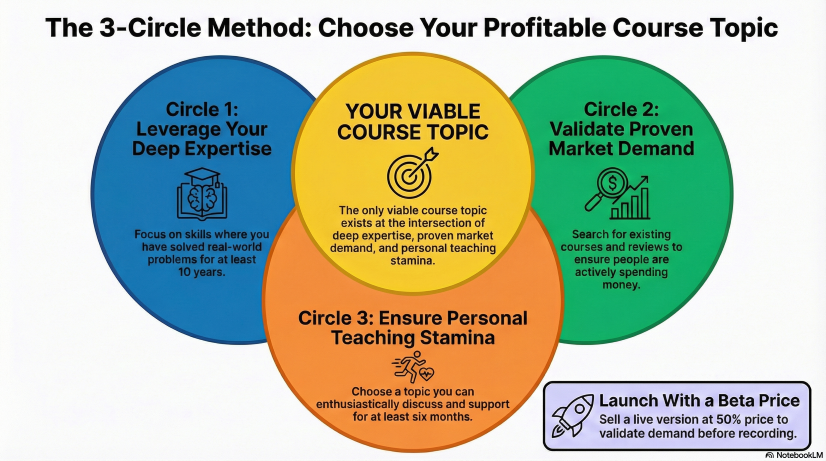
You have 30 years of expertise. Three possible course ideas. And absolutely no idea which one will actually sell. The hardest part of creating your first course isn't the technology or the marketing—it's choosing a topic that works at the intersection of what you know, what you love, and what people will pay for.
Circle 1: Deep Expertise
Your course topic must draw from genuine expertise, the kind others would pay a senior consultant to access. A good filter: focus on skills where you've solved real problems for at least a decade. If you wouldn't confidently coach someone one-on-one on this topic, don't scale it to a course.
Your "boring" corporate skills—the ones you think everyone knows—are exactly what people earlier in the career journey need. They don't need theory. They need your pattern recognition.
Circle 2: Market Demand
People need to be actively searching for solutions and willing to pay for them. Run these validation tests:
→ Search Udemy or Coursera for "[your topic] course" and if you see multiple courses with strong enrollment, there's demand
→ Check Amazon bestsellers in your niche and read the 3-star reviews as these show exactly what people paid for but didn't get solved
→ Confirm pricing—people currently pay $50-500+ for solutions in this space
These are practical filters, not rigid rules. But if you can't find evidence of real spending, you're guessing.
Circle 3: Teaching Stamina
Could you talk about this topic for eight hours without notes? Will you still care about it in six months when you're recording module 12? Passion isn't optional—it's fuel.
The Danger Zones
Here's what happens when you miss a circle:
→ Expertise + Passion - Market = A hobby, not income
→ Expertise + Market - Passion = High burnout risk
→ Passion + Market - Expertise = Credibility problems
The center of all three circles? That's a viable business.
Your first course doesn't have to be your best course. It just has to be the one you can confidently deliver and people actually need. Pick the overlap that feels obvious when you stop overthinking it.
Next Steps
⚡ YOUR FOCUSED ACTION THIS WEEK
→ Write down three potential course topics. For each one, honestly answer: Would I confidently coach someone one-on-one on this for $200/hour? Can I find 10+ existing courses on Udemy or Coursera with strong enrollment? Could I talk about this for 8 hours without notes? The topic that gets three "yes" answers is your starting point.
Want to go deeper?
📖 How to Choose Your Online Course Topic After 55: The 3-Circle Method: A comprehensive 2,500-word guide with validation tests, pricing strategies, the ADDIE framework, and FAQs on Social Security, tech anxiety, and the beta launch model. → Read the Full Article
🎯 Retirepreneur Hub: Access business templates, pricing guides, and startup checklists designed for 55+ entrepreneurs - completely free, no credit card required. → Join Free
🛠️ Kajabi: When you're ready to build a complete online course business, Kajabi provides an all-in-one platform for content, marketing, and payments. → Explore Free Trial
Keep building,
—Curt
Know someone who needs this? Forward this →